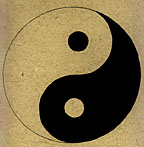
What is the Tao?
Tao means "Way of Life". We are all manifestations
of the Tao. However, the true Tao is above words and beyond description.
It is something that can only be experienced, not understood through normal
intellectual understanding. Lao
Tzu (approx 500 BC), the founder of Taoism, says: "Tao can be
talked about, but not the Eternal Tao".
The Tao originally manifested itself as the Wu
Chi, or the great undiferentiated origin of all things. It then divided
into Yin and Yang. The Tao is complete and has room for all
- good, bad, great, small, perverse, sacred, profound, simple. The above
circular Yin Yang figure represents the balance of opposites in the universe.
Can we study the Tao?
The Taoist thinkers would say that we can. This
is not a type of practice with techniques and goals; instead, we can learn
to relax into the course of events, and we become more aware of our place
in those events (while paradoxically becoming less aware of ourselves as
being separate from the events themselves). As we discover ourselves within
the Tao, we find a type of inner guidance. But Confucius had some good
reasons
to think that this practice is not so feasible.
Abstraction
Lao Tzu
When beauty is abstracted
Then ugliness has been implied;
When good is abstracted
Then evil has been implied....
The sage experiences without abstraction,
And accomplishes without action;
He accepts the ebb and flow of things,
Nurtures them, but does not own them,
And lives, but does not dwell.
[tr Peter A. Mere]
Perhaps a good way to understand Taoism is
to compare it with Confucianism since most ideas of Confucius are counter
to Taoism. Confucianism is concerned primarily with the needs of society,
and unlike Taoism, not the ability of a person to live in harmony with
nature. Lao Tzu felt that simplicity of the heart would lead to balanced
manners and rituals. But conservative Confucius felt that humanity needed
to be trained and controlled through strict observation of social rules.
Confucianism is a guide to morality and good government. Confucius stated
that the ideal person was one of good moral character. The ideal person
was also truly reverent in worship and sincerely respected his father (humm,
mother was not mentioned) and his ruler; so when these types of people
were rulers, their moral example would inspire the people to lead good
lives.
What is the difference
between Confucianism and Taoism?
Roughly, it's like the difference between an
"authoritative" government and a "laissez-faire" one. Lao Tzu is held to
be Confucius' real adversary. But it is more accurate to say that the essential
difference is the difference between Lao Tzu's direct way to the Tao and
Confucius' detour by way of the human order:
"Confucius represents the classical, Lao Tzu
the romantic,
Confucius stresses social responsibility, Lao
Tzu praises spontaneity and naturalness,
Confucius' focus is on the human, Lao Tzu's
on what transcends the human,
Confucius roams within society, Lao Tzu wanders
beyond."
Lao Tzu and Confucius
According to tradition Lao Tzu was the honored
master of Confucius. Legendary or true, it is told that Confucius, impressed
by Lao Tzu's influence on people, visited him once to ask advice, ironically
enough, on points of ceremonial etiquettes. It is also said that during
the meeting the founders of two influential yet contradictory philosophies
never got around to discussing their conflicting ideas. Lao Tzu was annoyed
that Confucius came to the meeting dressed in his most formal and elaborate
robe, as well as by Confucius' interest in the past.
"The men of whom you speak are long since
dead and their bones are turned to ashes in their graves."
Confucius tried to explain his belief that new
knowledge must be based upon old knowledge. Lao Tzu interrupted him saying:
"Put away your polite airs and your vain display
of fine robes. The wise man does not display his treasures to those he
does not know. And he cannot learn justice from the Ancients."
"Why not?" asked Confucius.
"The swan does not need to bathe daily to
remain white" was the answer of Lao Tzu. And he abruptly ended the
interview.
Confucius went off and said to his disciples:
"I know that birds can fly and fish can swim and beasts can run. Snares
can be set for things that run, nets for those that swim and arrows for
whatever flies. But who knows how Dragons ride the wind and cloud up into
the sky. Today I saw Lao Tzu. What a Dragon!'"
What did Confucius think of the Tao?
My favourite quotes
about Confucius
"I admire Confucius. He was the first man who
did not receive a divine inspiration."
Voltaire
"The study of the Confucian philosophy is of
greater
profit than that of Greek." Ezra Pound
"Superior and alone, Confucius stood
Who taught that useful science -- to be
good." Alexander Pope
"I haven't ever refused to teach anyone who made
at least token payment." The Master Confucius
Some Taoism-related resources
Taoism
and Anarchism
Stories
from Chinese Classic Literatures

"How can we be sure of what we are seeing?" or the issue the interchangibility of appearance and reality was one of his main interests, and Zhuang Tzu thinks that much of the meaning of the world is bound up in apparent contradictions.
Zhuang Tzu also says "enjoying life is just a delusion"!!!Butterfly philosopher One day about sunset, Zhuang Tzu dozed off and dreamed that he turned into a butterfly. He flapped his wings and sure enough he was a butterfly... What a joyful feeling as he fluttered about, he completely forgot that he was Zhuang Tzu. Soon though, he realized that proud butterfly was really Zhuang Tzu who dreamed he was a butterfly, or was it a butterfly who dreamed he was Zhuang Tzu! [tr. Brian Bruya]
Between Tzu and the butterfly there must be some distinction, but one may be the other.
The fable told by Zhuang Tzu that I like most is about two people who were trying to create seven apertures for an emperor who had been deprived of them, made him die. This is the Zhuang Tzu philosophy of "doing through not doing".
His mystical style contributes to the tendency to treat him as an irrationalist. But his fantasy was also intended to talk down to rational Confucius.
Zhuang Tzu's Story of Three Friends
There were three friends discussing life. One said: "Can we live together and know nothing of it, work together and produce nothing? Can people fly around in space and still forget to exist. World without end?"
The three friends looked at each other and burst out laughing. They had no explanation. Thus they were better friends than before. Then one friend died. Confucius sent a disciple to help the other two chant the traditional funeral ritual. His disciple found that one of them had composed a song. While the other played the lute, they sang:
"Hey, Sung Hu! Where'd you go?
You have gone where you were before.
And we are here - Damn it! We are here!"
Then the disciple of Confucius burst in on them and exclaimed: "May I inquire where in the funeral ritual it allows you to sing so irreverently in the presence of the departed?". The two friends looked at each other, smiled, and said: "Well trained in liturgy, but the poor fellow doesn't understand life and death!"
If you want to read more
philosophical fantasy of Zhuang Tzu.